Muse
An AI-Powered Social Vibe Check and Topic Generator that helps semi-strangers discover common ground and spark meaningful conversations in real time.
This case study is a conceptual exploration, designed to solve a real social problem through thoughtful UX and prototyping.
Role:
Full Stack Designer
Timeline:
Sep - Dec, 2025
Team:
Individual
Skills
Concept Development
User Research Prototyping
Visual Design
Do you ever feel it’s hard to have a real conversation
with someone else?
For many introverts, social settings feel like a mental obstacle course... Full of forced small talk, shallow topics, and that moment you check your phone just to avoid the awkward silence.
Sooo… do you come here often?
Uh, it’s my first time.
[long pause]
Cool… yeah… same.
[Both glance at their phones]
This project grew from my own discomfort with starting conversations, a quiet struggle that made me wonder: what if connection could feel easier?
“In social gatherings made just for the sake of mingling, I feel like fleeing.”
“Sometimes I spend a long time thinking how to start, but end up not speaking at all.”
“The conversation sticks to one topic, and once it's over, there’s no more talk.”
Quotes from user interview
How might we support young individuals in easing into meaningful conversations, without making it feel like a chore?
Here’s my Design Goals:
Make socializing feel organic, not like doing homework
Make it easier to start conversations in socially delicate moments
Create emotionally safe, low-pressure entry points
Help users discover shared interests or moods naturally
What’s Really Going On Here?
From the Desk Research,
48%
of young adults (18-29) report experiencing social anxiety that interferes with daily interactions, including initiating and maintaining conversations.
(National Institute of Mental Health)

So, I Talked to People…
To move beyond assumptions, I spoke with introverts, overthinkers, and semi-strangers. I wanted to hear how they experience the awkwardness of starting conversations, and what makes it feel easier (or not).
What I heard went beyond awkward silences, they shared the subtle reasons real conversation feels hard to start, and here’s what I learned from those conversations:
# 1
Conversations Feel Draining Without the Right Setup
Many participants feel anxious, overstimulated, or unsure in the early stages of interaction—especially in public or formal settings. This hesitation stems not from a lack of interest, but from an internal pressure to “perform” or navigate ambiguous social cues.
# 2
Emotional safety is essential, depth and comfort must be user-controlled
Users disengage when conversations are either too shallow (surface-level or lacking shared meaning) or too deep too quickly (with intrusive questions or overly enthusiastic people). Both extremes create emotional distance.
# 3
Shared Interests Spark Real Connection Faster
When users see mutual context (same school, shared space, hobbies), they feel safer and more open. Similarly, they warm up more easily when the other person is the first to share or engage empathetically—especially when it feels spontaneous or unforced.
# 4
Subtle social cues like reactions and vibes matter more than words
For some users, active listening, visual focus, or even shared silence feel more valuable than constant back-and-forth dialogue. Nonverbal cues, reactions, and environment shape whether they stay engaged.
Affinity Mapping
Turning Insight Into Solution

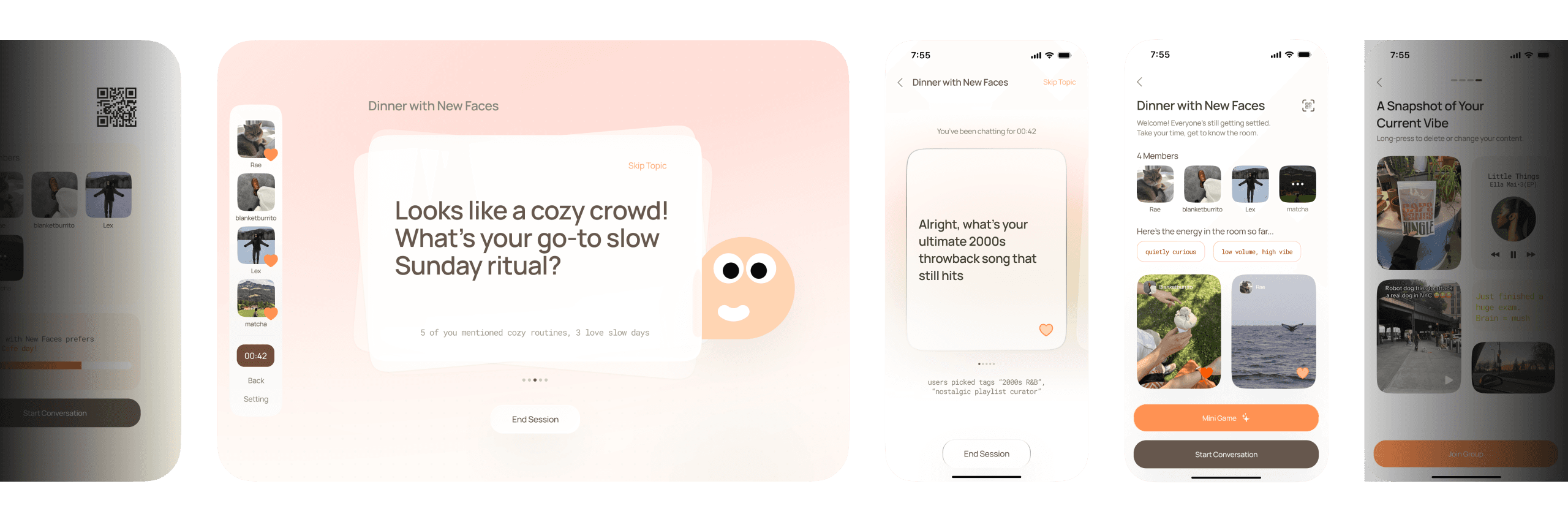
Muse: An AI-Powered Social Vibe Check & Topic Generator
To make socializing less awkward and more intuitive, I designed a group-first experience to help semi-strangers ease into connection by finding emotional common ground without pressure.
Whether on a phone or a shared tablet, Muse picks up on shared vibes, tags, and visuals to spark conversation naturally.
Hero Feature: AI-Powered Group Topic Generator
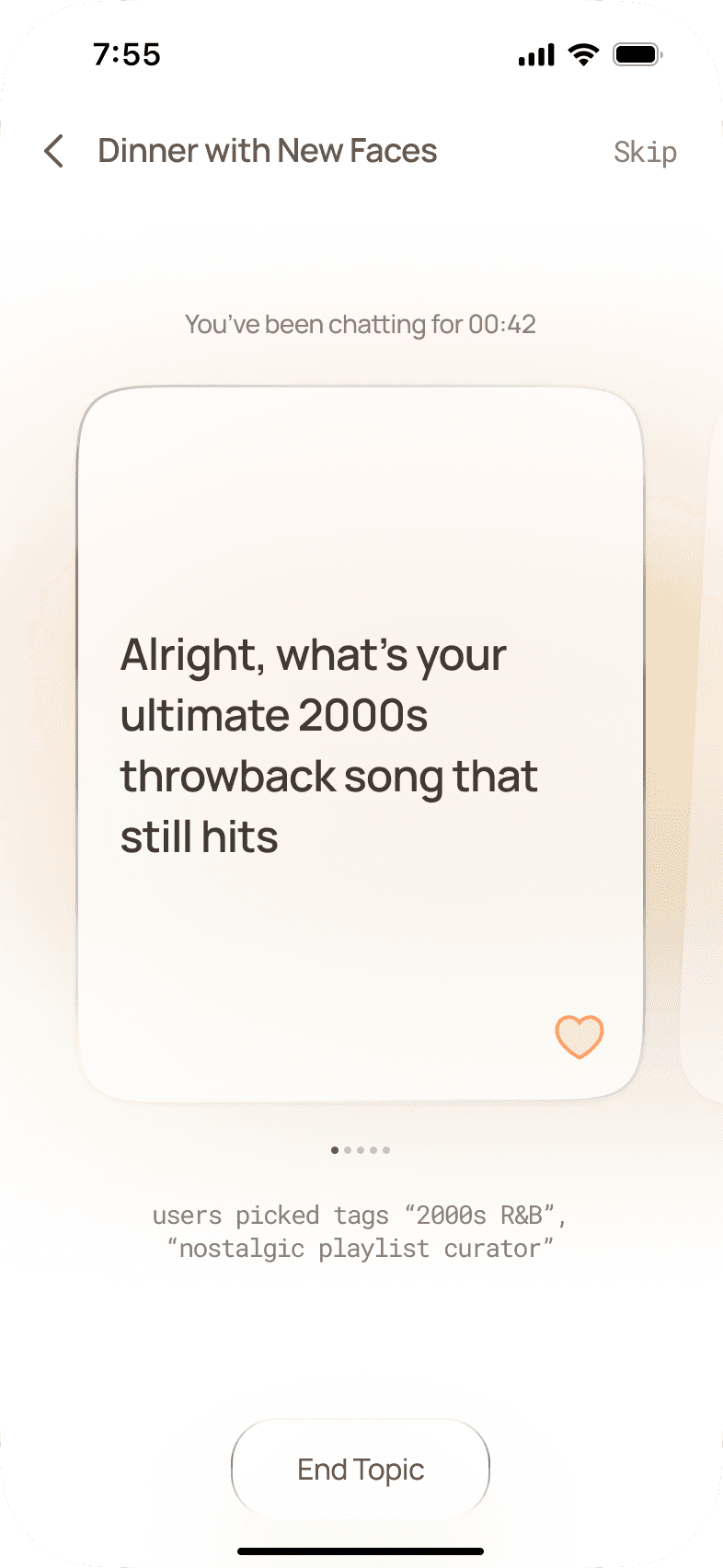
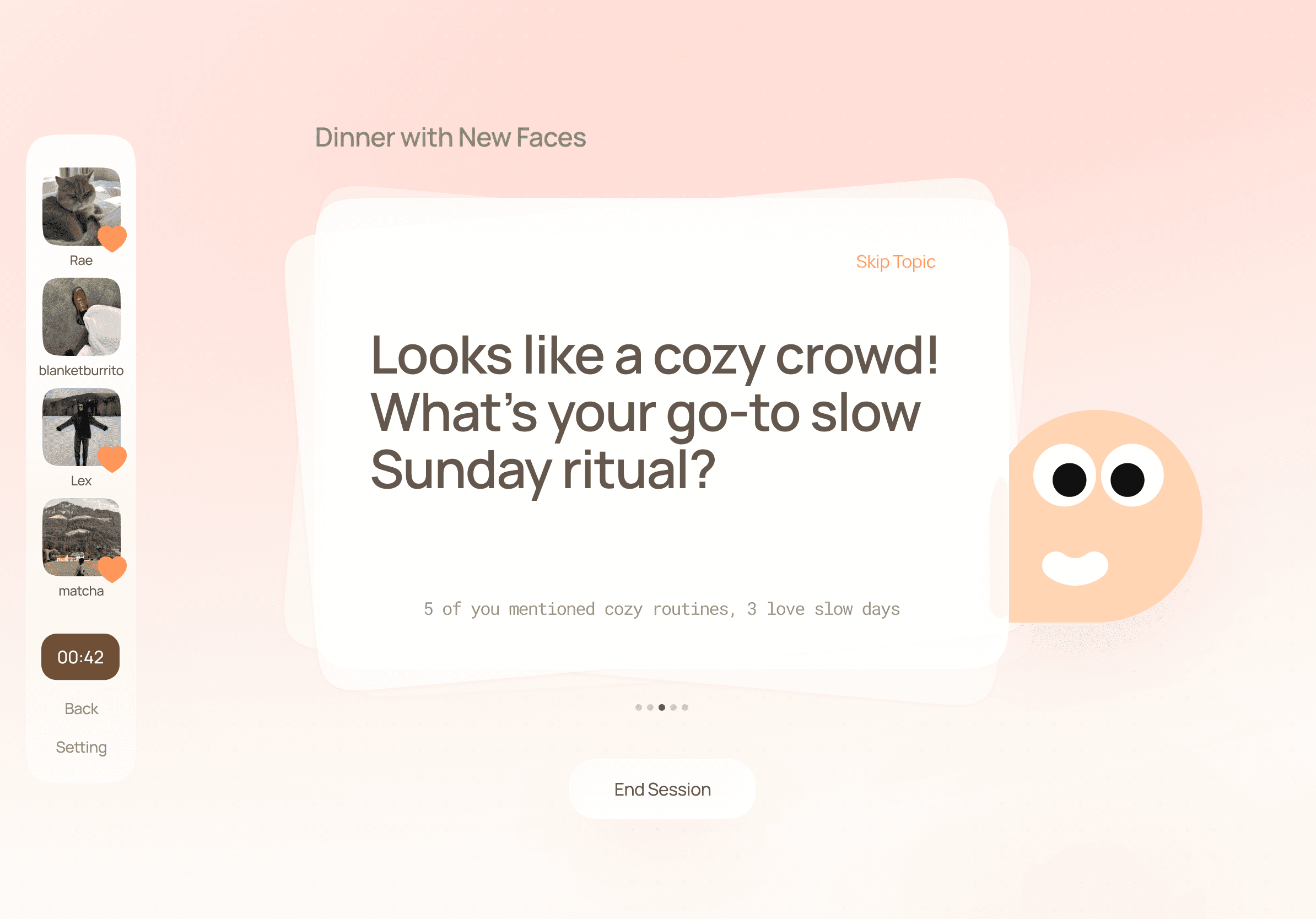
Skip, swap, or end. All interactions are low-pressure by design.
Little bubble face mascot makes it emotionally disarming
So… what’s the vibe, and how can everyone join in?
Instead of pushing random icebreakers, Muse listens quietly first, then gently suggests a group topic that feels like everyone belongs.
Detailed design iterations are coming up next!
Feature 2: Moment-Based Profile Expression
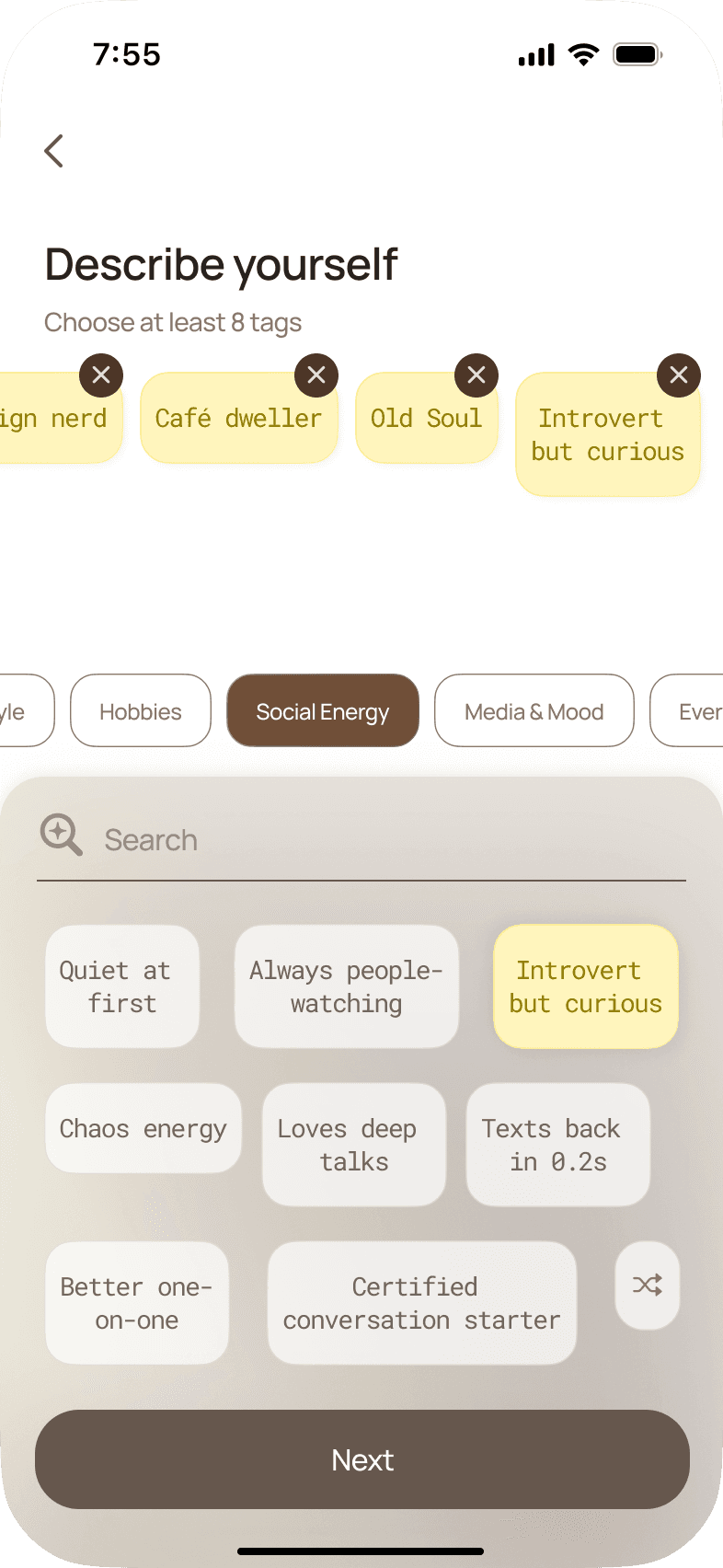
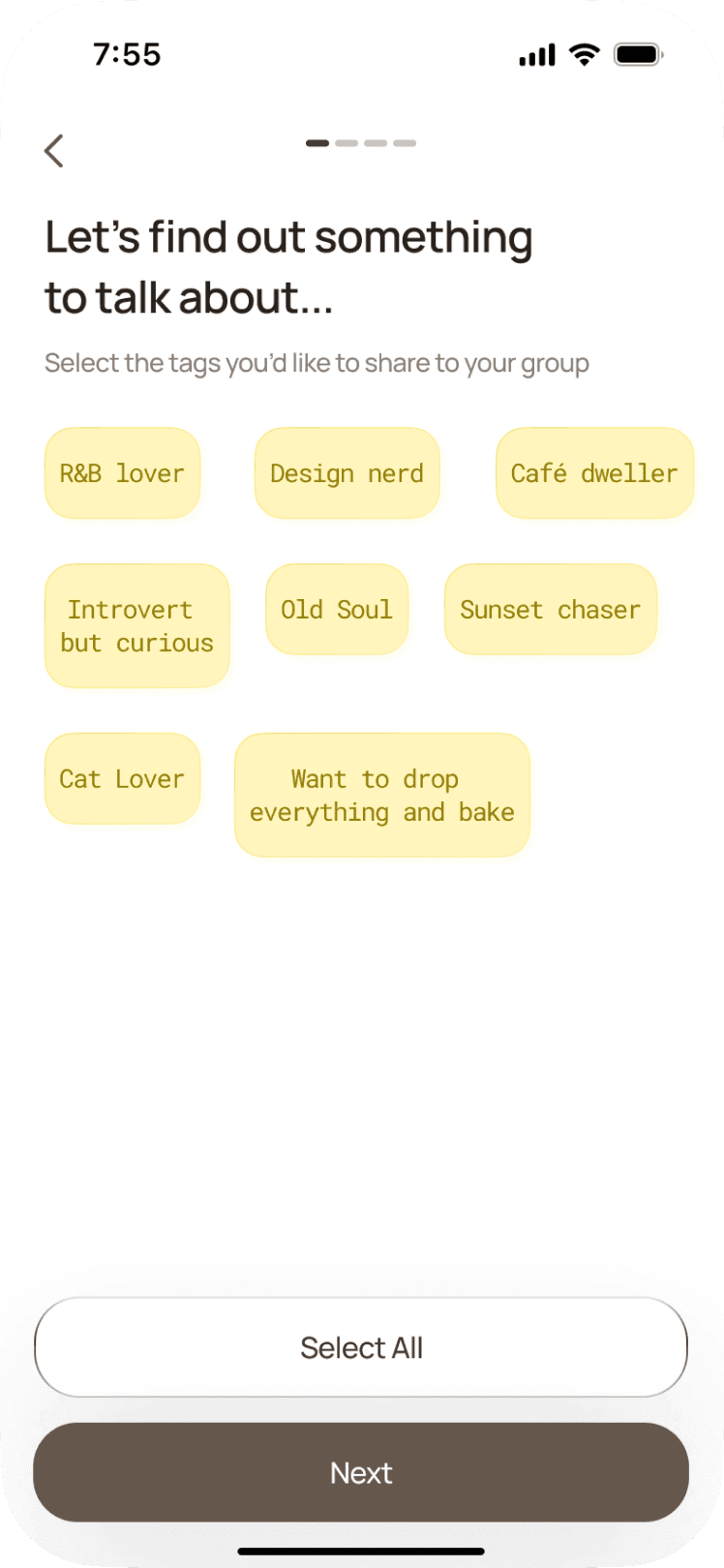
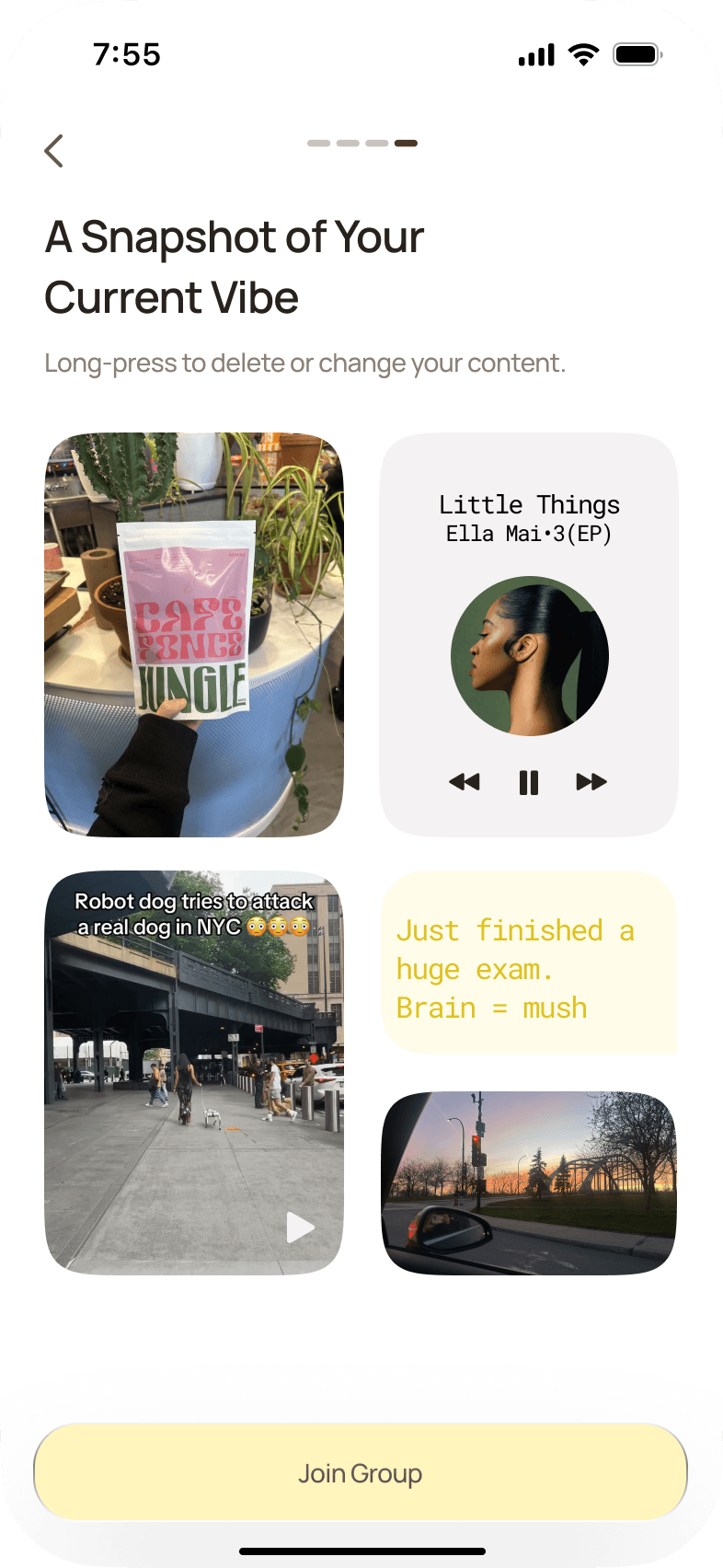
I choose rounded tags and containers to reduce pressure and make the interface feel more human, more inviting.
“What do you feel like showing today?”
Muse invites users to express their current self through soft-edged tags, mood snippets, and casual visuals.This lightweight snapshot reflects how someone feels right now, not who they are forever.
Feature 3: Emotional Waiting Room
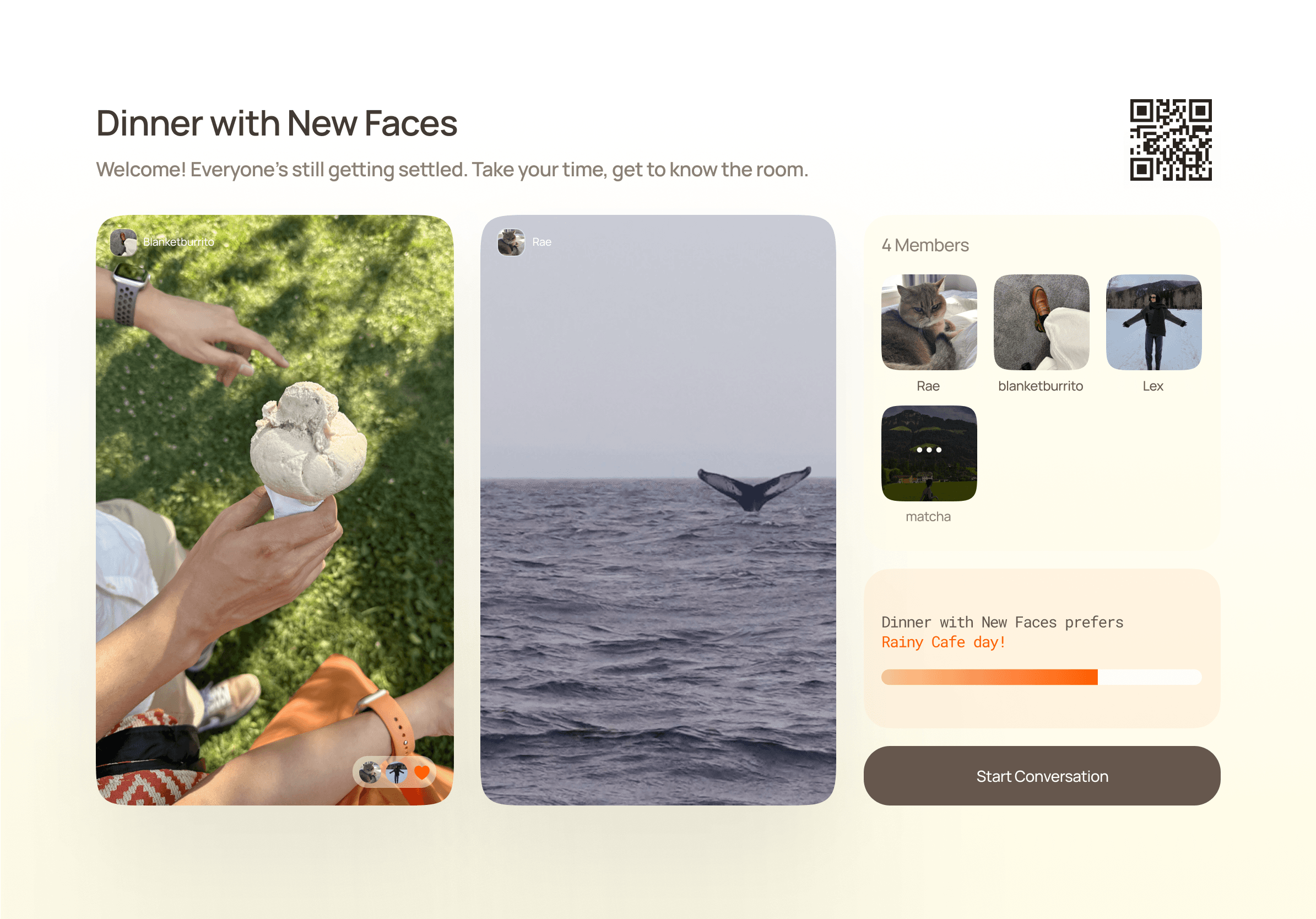
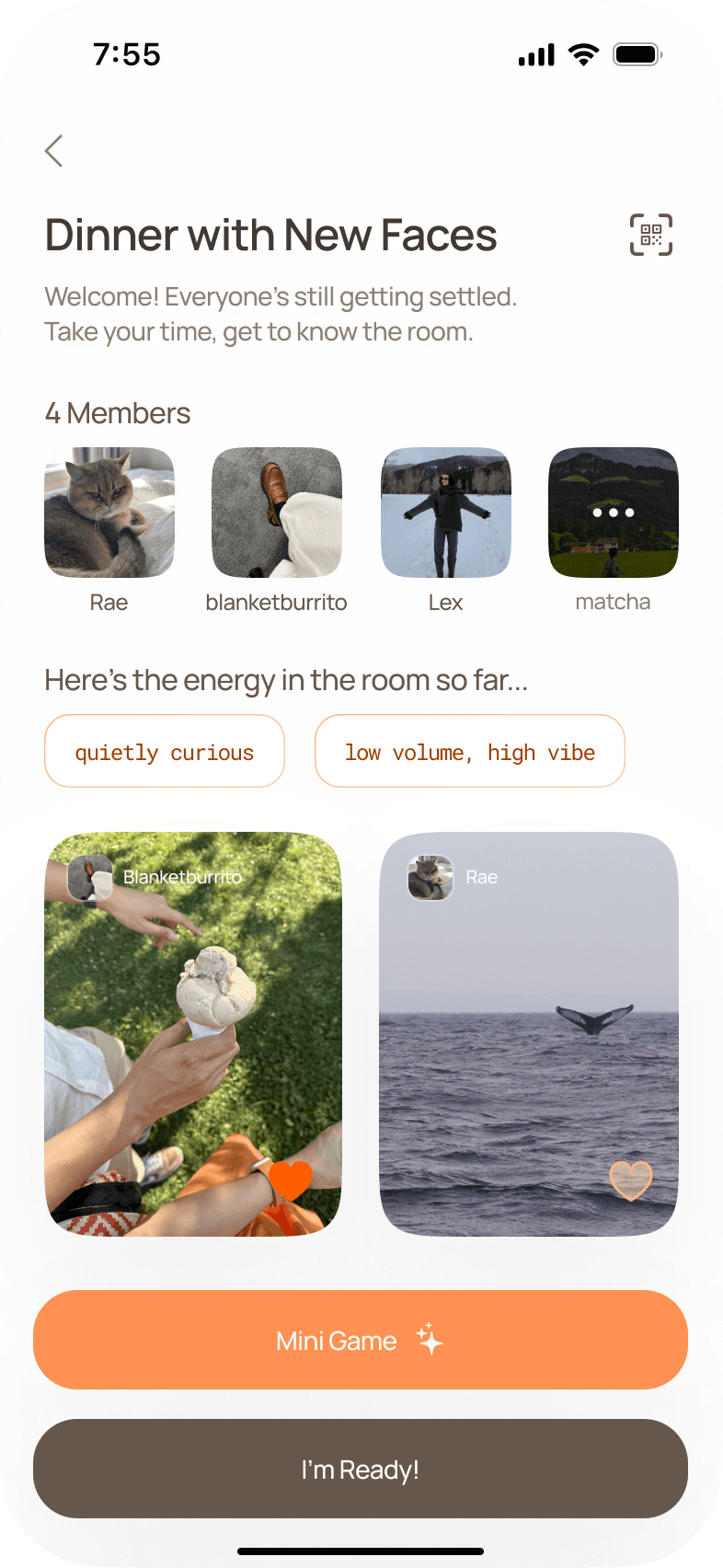
“Before diving into convo, take a moment to warm up.”
People don’t always walk into a room ready to talk. Sometimes they need a second to read the vibe.
When users arrive, they’re not thrown into a chat. They get a quiet space to observe the room’s energy, scroll through recent moments, and ease in naturally.
Feature 4: Talk Spark (1:1 Conversation Assist)
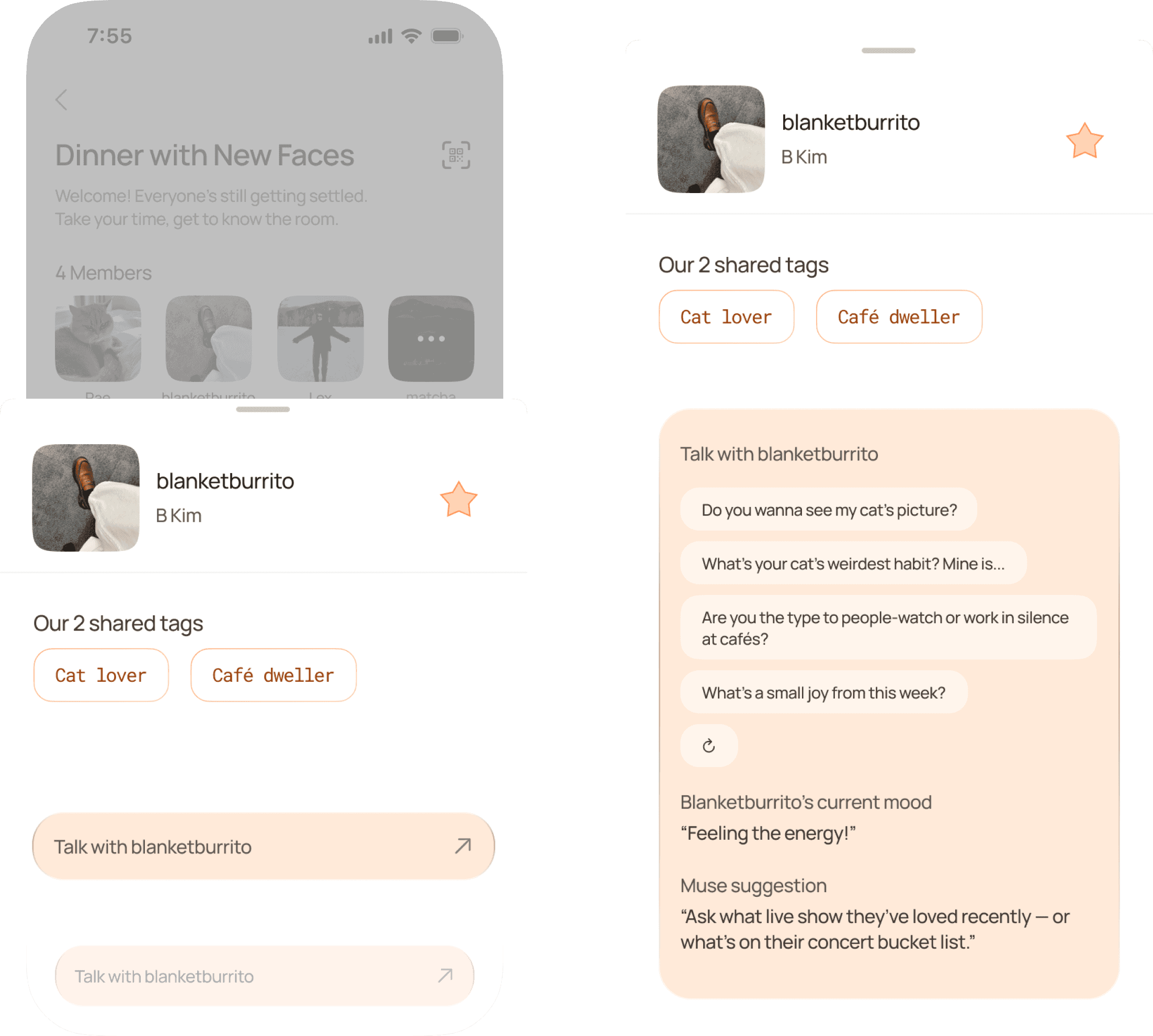
“I have to rehearse the starting line in my mind so many times because I don’t know how to begin.” – YJ, user interview
This inspired Muse’s gentle 1:1 conversation assist based on shared vibes and tags.
I created a low-pressure space where users can explore someone’s current vibe and shared tags. It also helps spark 1:1 chats by gently suggesting casual conversation starters based on tone, context, and mutual curiosity.
