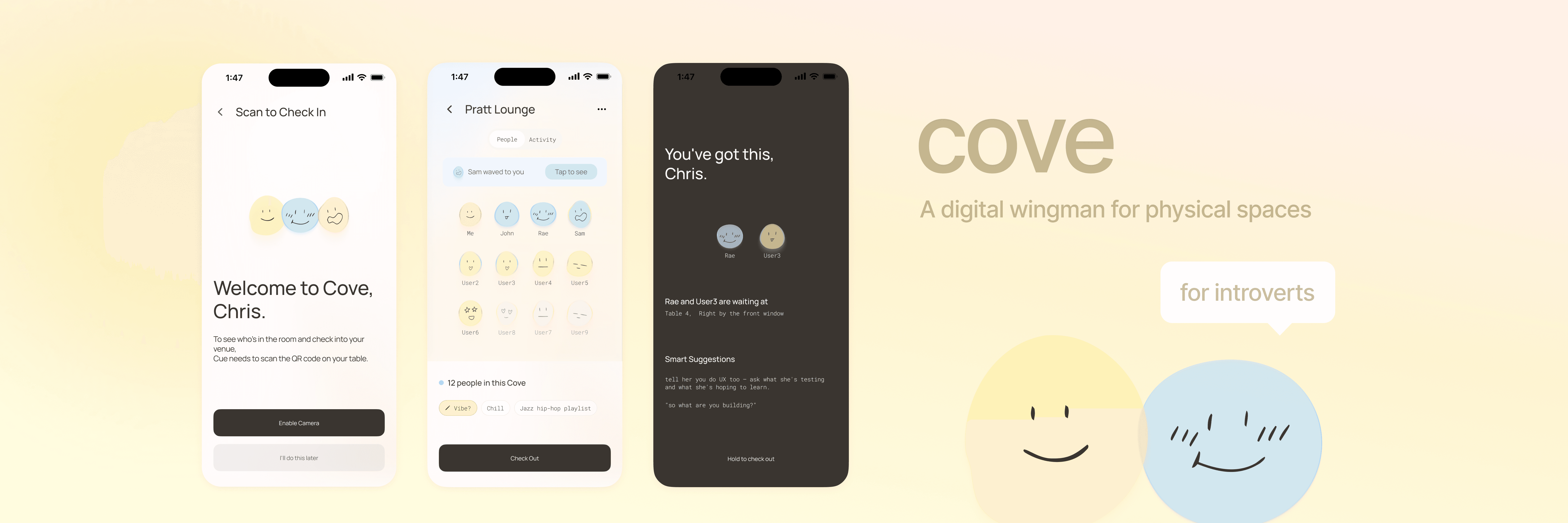
Cove: A digital wingman for physical spaces
A mobile concept that helps introverts cross the four feet between two cafe tables. It does one thing well: gets you off your phone and into the room.
This case study is a conceptual exploration, designed to solve a real social problem through thoughtful UX and prototyping.
Role:
Full Stack Designer
Timeline:
Feb - May, 2026
Team:
Individual
Skills
Concept Development
User Research
Prototyping
Visual Design
Problem
Why is saying the first hello so hard?
For many introverts, social settings feel like a mental obstacle course. You walk into a cafe or a student lounge, end up next to a stranger, and the moment the silence gets heavy, you check your phone, just to have somewhere safe to look.
Here's my typical conversation flow


[Both glance at their phones]
This project grew from my own discomfort with starting conversations, a quiet struggle that made me wonder: what if connection could feel easier?
“In social gatherings made just for the sake of mingling, I feel like fleeing.”
“Sometimes I spend a long time thinking how to start, but end up not speaking at all.”
“The conversation sticks to one topic, and once it's over, there’s no more talk.”
Quotes from user interview
Initial HMW statement
How might we help young adults connect in social spaces without the process feeling like an exhausting chore?
My design goal is to:
Make socializing feel organic, not like doing homework
Make it easier to start conversations in socially delicate moments
Create emotionally safe, low-pressure entry points
Research
Wait, is this just me?
From the desk research,
48%
of young adults (18-29) report experiencing social anxiety that interferes with daily interactions, including initiating and maintaining conversations.
(National Institute of Mental Health)
To move beyond assumptions,
I spoke with 6 introverts

I wanted to hear how they experience the awkwardness of socializing in the physical space, and what makes it feel easier (or not).
And I wasn't alone in this
What they told me completely validated my own experiences.
They shared the subtle reasons real conversation feels hard to start, and here’s what I learned from those conversations:
1. First-Move Anxiety
Introverts don't hate talking; they just freeze when trying to invent an opening line
The Fear of Intrusion and Rejection
Everyone hates being rejected, but for introverts, it cuts deeper :(
The Need for Low-Stakes Engagement
Introverts get socially fatigued very quickly, especially when forced into overly personal or unrelated topic.
And this one quote from one of my user research participants:
“Sometimes I spend a long time thinking how to start, but end up not speaking at all.”
That defined the exact moment I needed to design for.
So I narrowed my focus to that one phase:
The initial moment of connection.
How might we remove the fear of the 'first hello', so introverts feel safe initiating organic, in-person conversations?
Design Solution
Turning insight into solution
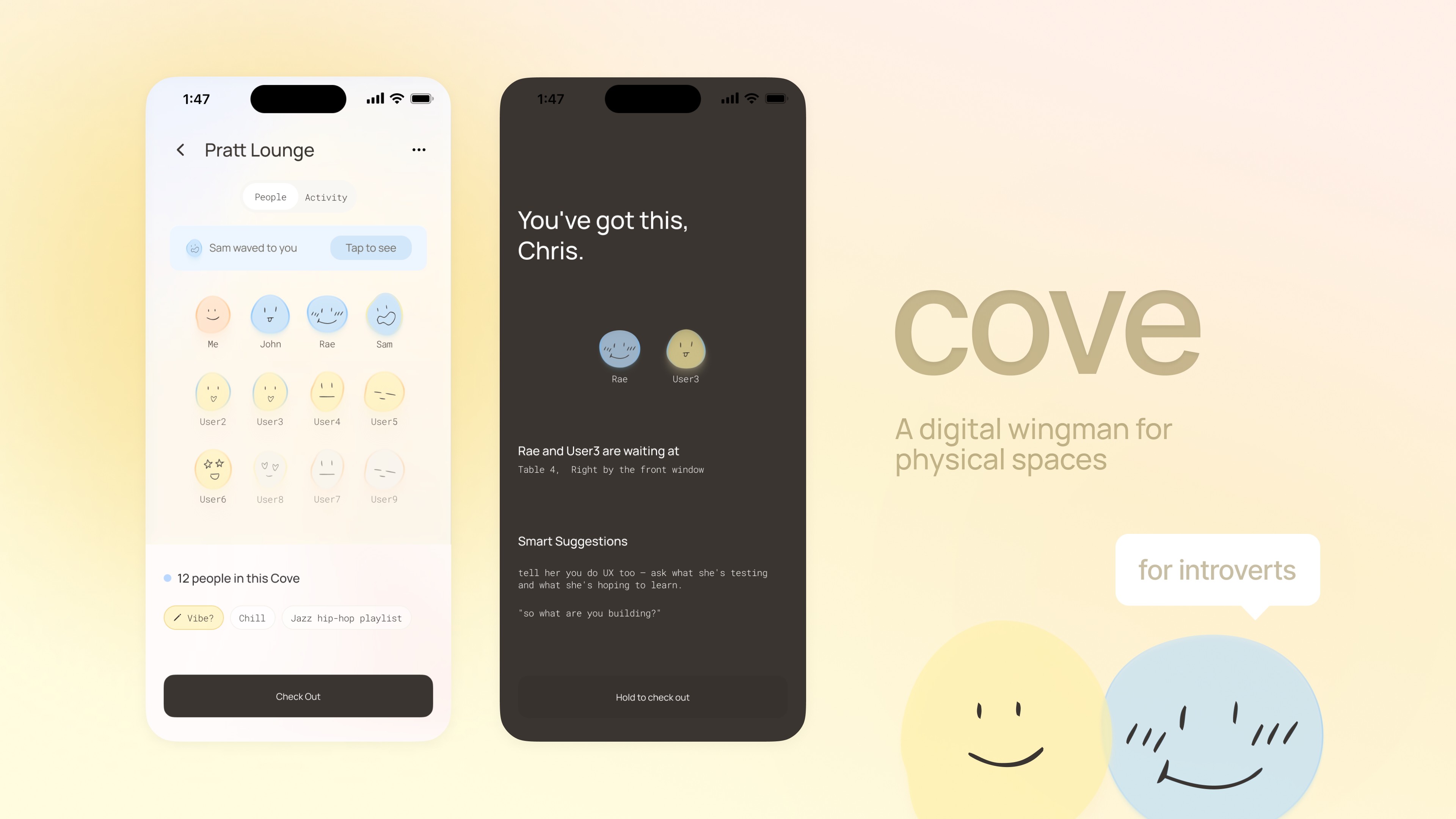
Cove: A digital wingman for physical spaces
To make socializing less awkward and more intuitive, I designed a tool that does the hardest part, the first hello, without the pressure of doing it alone. Cove.
Onboarding to Check-in
Profile Setup Identity in Cove is meant to feel light. A hand-drawn blob avatar replaces the profile photo. For a first-time user, they setup the account and select their interest tags, which becomes the crucial data that powers our AI later.
Check-in & Vibe The QR code on the table is the actual door into a Cove. Before you appear in the room, you pick a vibe: Open to chat, Only if we match, or Just exploring (ghost mode).
The Hero Feature: One Tap, One Wave


Wave sender POV
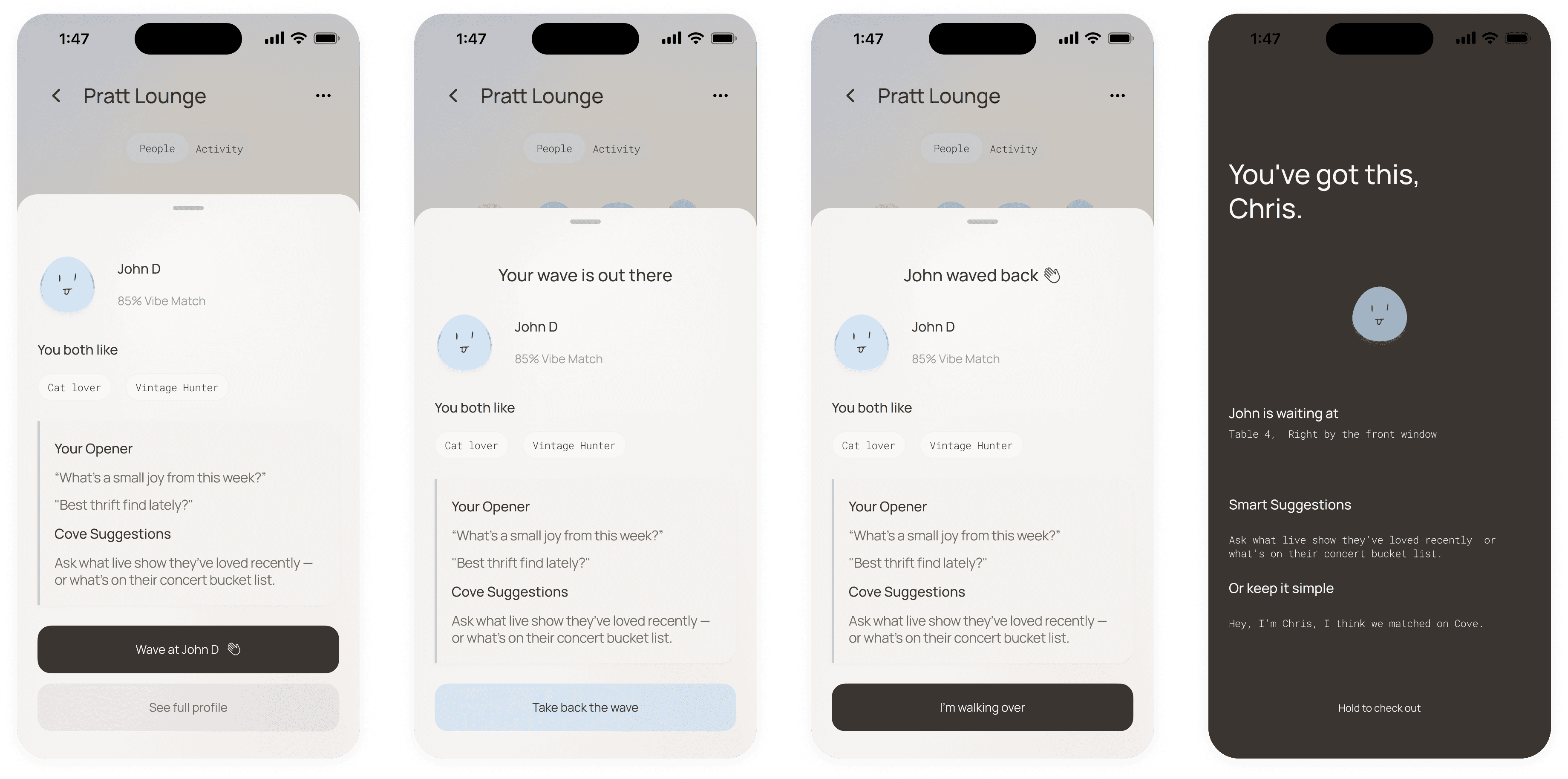
Instead of a terrifying cold approach, user taps 'Wave at john.'
This creates low-stakes engagement, and user can always take back the wave. A few moment later, If accepted, we can move forward.
To cure the anxiety of not knowing what to start for the conversation,' the AI uses their shared tags to generate lightweight icebreakers. User reads the cue card, takes a breath, and taps, 'I'm walking over.
That triggers Focus Mode. The screen strips down to John's location, one backup opener, and an exit button. The digital wingman has done its job, and is now gently pushing user off the phone and into the room.
Wave receiver POV
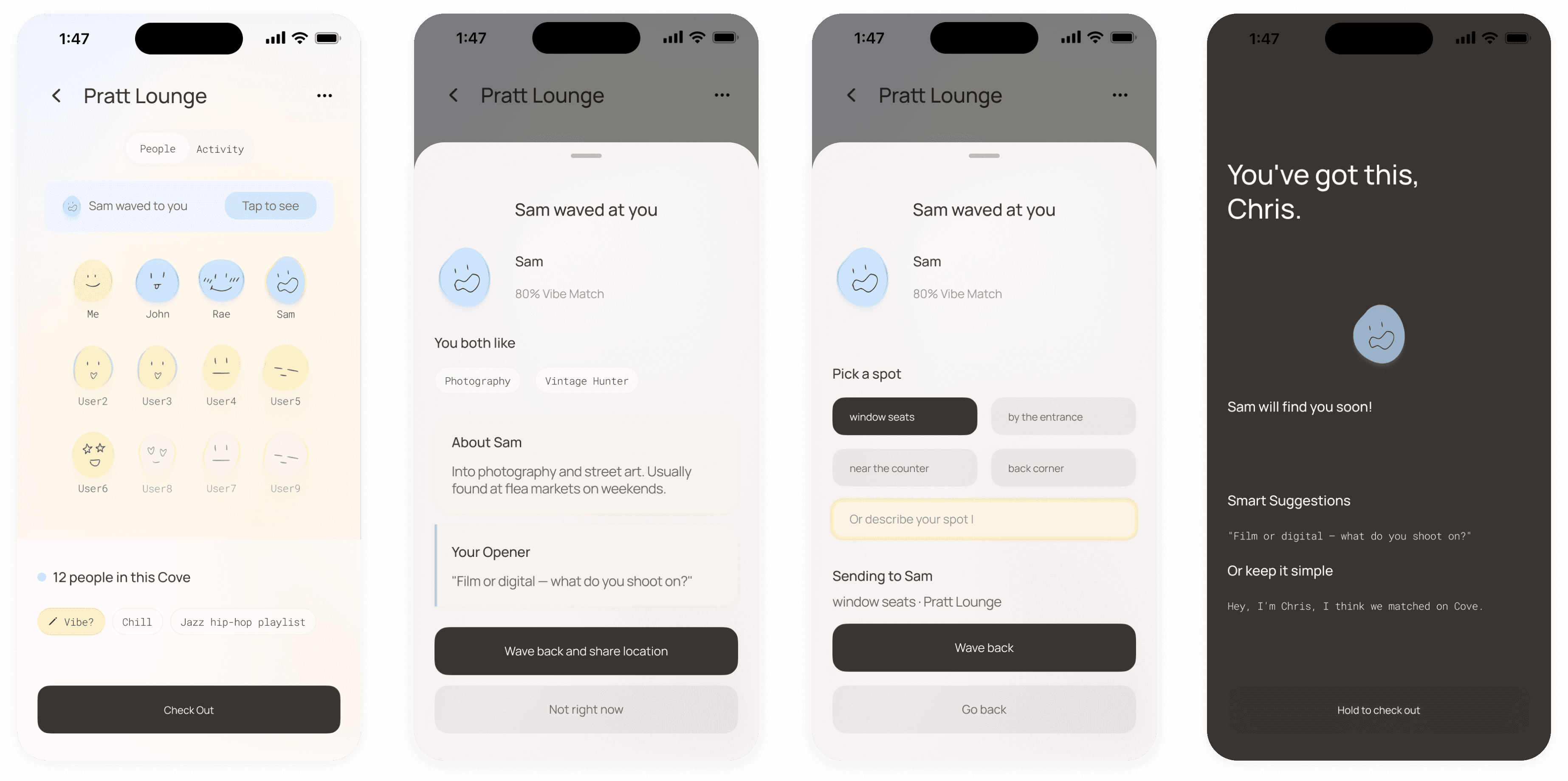
Now, someone sent user the wave, to view this invitation,
User can click into see his profile, and decide if he wants to connect with Sam.
User found that Sam is also interested in photography and wanted to wave back and share his locaiton, he picked a spot to meet and wave back.
From here, the flow funnels into the same Focus Mode, and the rest happens face-to-face.
The visual language underneath it all

Every screen above runs on the same small set of decisions:
Cove chose a warm, muted palette, soft yellows, dusty blues, and a touch of Glow orange for moments that need energy.
The hand-drawn avatars carry through the entire product so the whole experience feels warm and welcome.
Design Iteration & Testing
Of course,
The design didn't land here on the first try.
Here's the visual language I built, and the features I rebuilt, removed, and rethought along the way.
From sketches to Mid-Fi to Hi-Fi
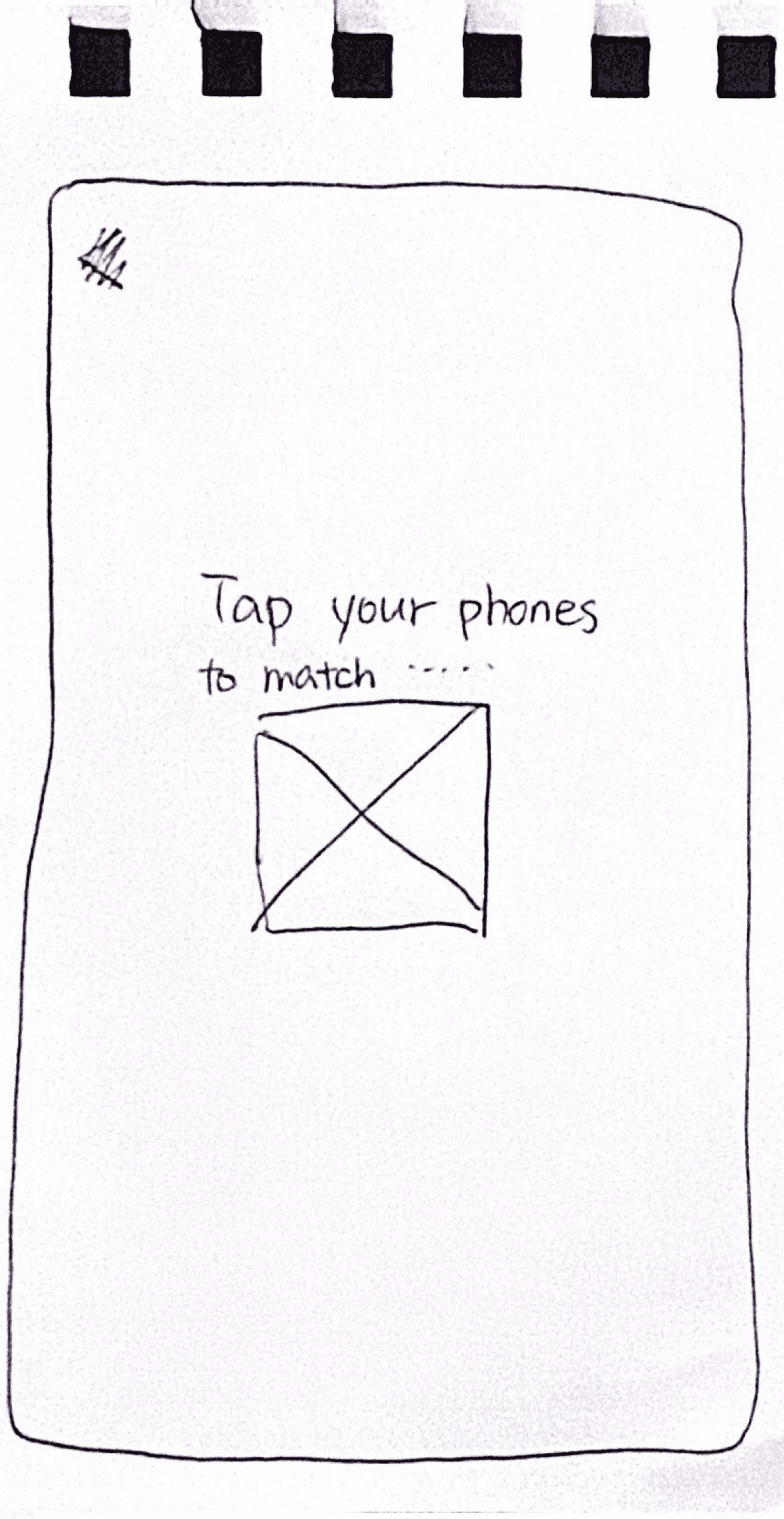
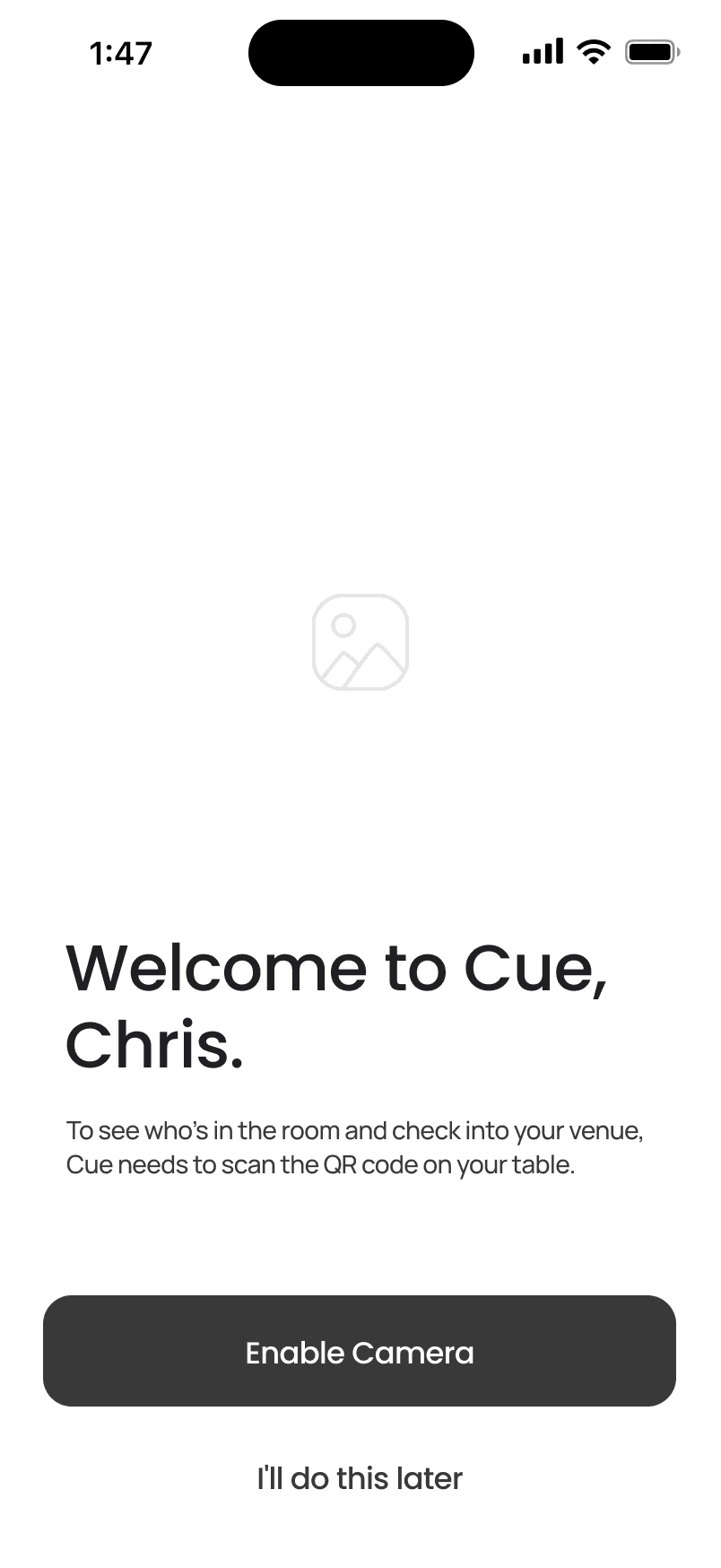
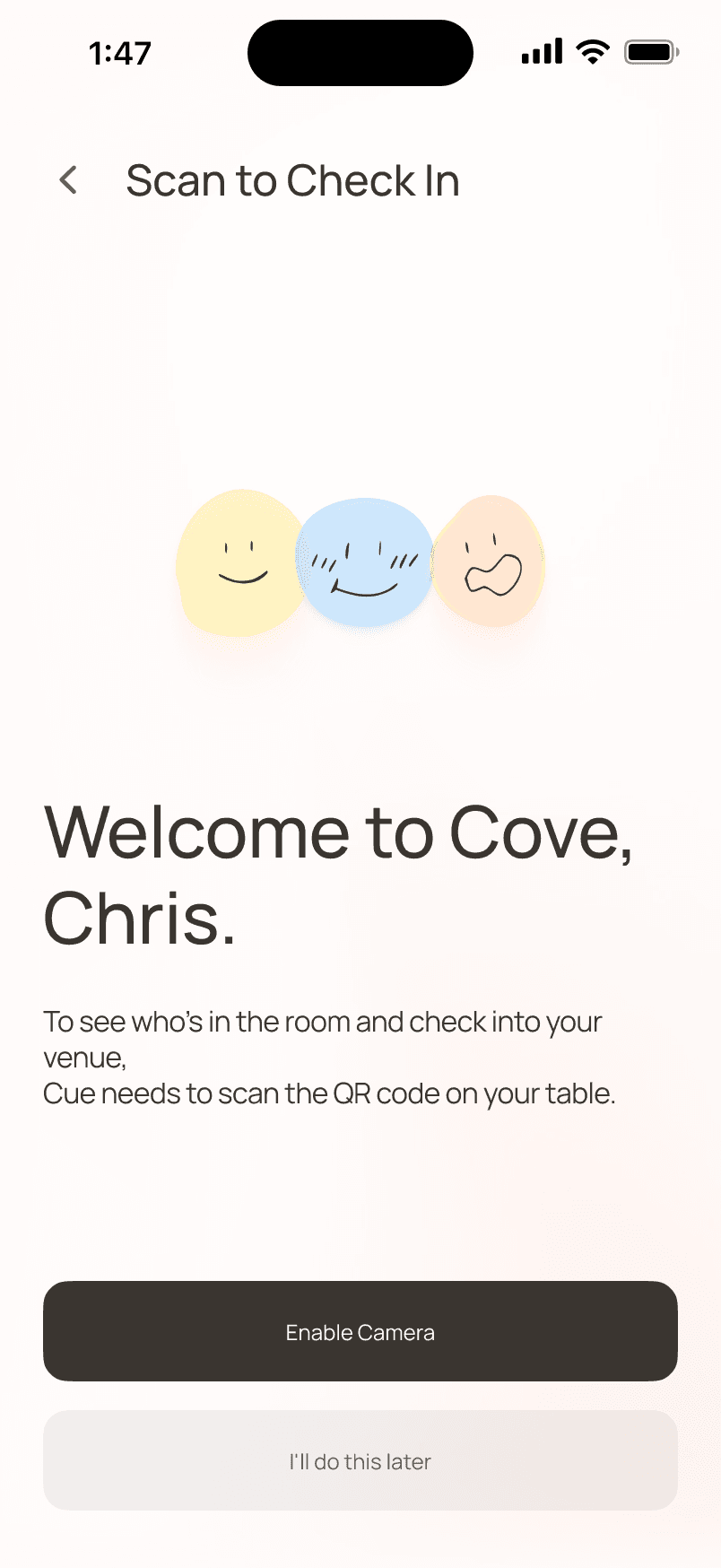
It went through multiple iteration and 3 versions before it felt right, even the name 'Cove' arrived late !
One iteration in particular...
There was one feature I was sure would work.
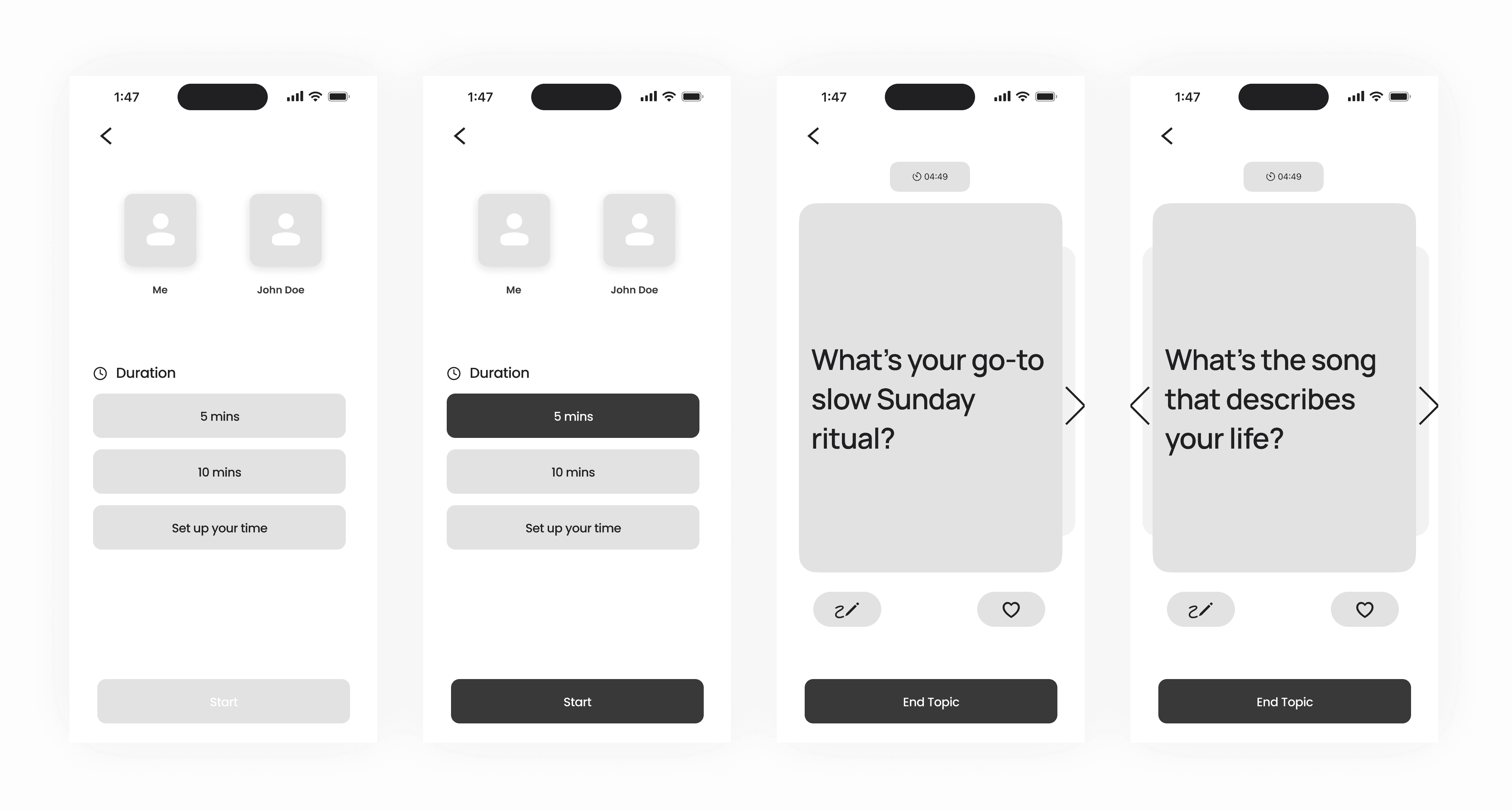
I'd designed a topic generator: two users could open their phones mid-conversation and flip through AI-generated topic cards together. I was sure it would help.
Then I tested it 5 target users.

2/5 participants responded that they will use the topic generator
The reason was unanimous, and one quote said it best:
"I don't think I'd open my phone in the middle of a conversation with someone I just met. It feels rude."
They were right. I'd quietly built the thing I promised not to build: a phone-based interaction dressed up as a conversation tool. It violated my own principle.
Cove was supposed to be a wingman, not a chat app.
So I cut the entire flow.
The lesson stuck: designing for anxious people isn't about giving them more tools at the moment of pressure. It's about giving them fewer decisions to make. Every feature I cut after this point made the product calmer.
Wrapping Up
I presented it to the class and the outside panel
I presented Cove to my class and an outside panel of designers and professor. The feedback clustered around two themes:
The visual language landed — "calm, warm, matching the concept," in one panelist's words.
And the narrative arc held through to the end — "I loved how the story developed!"
What's Next
Broaden the research
So far, Cove is designed for Introverts, but I believe the problem isn't exclusive to them.
A lot of people feel the anxiety of that first hello, regardless of personality type. I want to expand my audience, and want to understand how Cove could serve a wider range of people.